Robert Lewis, DHSC Mental Health Social Work Lead in conversation with Fazeela Hafejee, Assistant Director for Adults with Disabilities, Bradford – carried out on 25th February 2026.

Introduction by Robert Lewis
Ahead of Social Work Week, I invited Fazeela Hafejee to offer her reflections on how identity, place and values shape her leadership in adult social care in the context of this year’s theme of the Harambe call to unite a divided society. Drawing on lived experience, professional practice, leadership and the dynamics of life in Bradford, Fazeela offers a compelling vision of social work as a relational, community-rooted profession with a vital role in uniting a divided society.
On identity, leadership and early influences
Robert Lewis
Can we start by telling us a little about yourself, Fazeela, your current role, and perhaps how you see your identity helping shape your work in Bradford.
Fazeela Hafejee
I still see myself as little old me, someone who kind of fell in love with social work at 14. I had met an education social worker who was engaged with a neighbour. She always treated the family with dignity, curiosity and humanity. She never knew the impact she had on me, and if I told my kids that I wanted to be a social worker at 14, they would think it's so uncool because they all want to be influencers. I carry those same early lessons with me into leadership that I saw in that education social worker.
I'm visibly Muslim. I'm a woman of South Asian heritage. I'm the first female to go to university in my family. I grew up navigating that tension between cultural expectations and my kind of personal ambition to have a career, and that wasn't easy. Those experiences have taught me a lot that I bring into social work, which is around resilience, being creative - because stamping your feet and saying I will go to university wasn't an option for me. The idea of allyship also became important for me at that time.
Now when I go into rooms, I notice who isn't in the room. I try and notice whose voice is quieter, who needs a door to open. I think those are important attributes that come with time and experience. Probably when I was younger, I felt the need to speak more than probably was necessary. Now I think it's all right to be quiet and it's all right to observe - that comes with time. Social work reflection has also had a huge impact on my life and work.
I suppose identity matters because it shapes how I lead. I'd like to think I lead with cultural humility and a deep understanding of inequalities and a commitment to creating spaces where everyone feels seen, and that can really happen in a social work space. Bradford's diversity mirrors parts of my own story. It's really personal, it often comes with a lot of negative stereotypes, feels like a place where difference isn't something that you manage. It's a source of strength. It's a source of innovation. A place where you feel that you can belong. I think that those are really important in leadership, my role and identity, and how I shape my work.
On safety, visibility and allyship
Robert Lewis
I love that notion of “difference isn’t something that you manage”. Many of our communities are under a lot of pressure from politically divisive narratives. How does that feel in the context of having a senior leadership role in a city that has had a negative spotlight, even while simultaneously hosting a successful City of Culture last year? Does it feel safe? Do you feel supported?
Fazeela Hafejee
I think in a national context, it feels unsafe. I feel going about your day-to-day life feels unsafe. But in my role, in my job in Bradford, it feels really safe. I'm really lucky. What I've been able to do in my role here is to own that space. So not only am I an assistant director, I am visibly Muslim, and I don't shy away from that. And I've been able to do lots of things in Bradford.
It's Ramadan at the moment. We do a session every year on how you support colleagues who might be fasting during the holy month, and how you support people who draw on care and support in that month as well?
The session was facilitated by a colleague of mine who is Muslim and another who is our Principal Social Worker and not Muslim. We often talk about how he sometimes feels like an imposter — questioning, as a white man, whether he should even be delivering this session. But for me, that’s exactly where allyship lives: in showing up, in being willing to hold space, and in using your position to support others. That’s why I think it’s so powerful that he chooses to step into that role.
I think in this local authority, being visibly Muslim is not problematic. Actually, I see that as something that I own and use it as an opportunity to talk about all the stuff that we are talking about in “Unite in a Divided Society” (this year’s World Social Work Day theme) and how do you use your leadership and the fact that you are different as an advantage?
On social work and uniting a divided society
Robert Lewis
That does bring us neatly to the theme for 2026’s World Social Work Day, as you say, that Harambe call to unite a divided society. What does that then mean for you and what do you see the role for social work in all of this?
Fazeela Hafejee
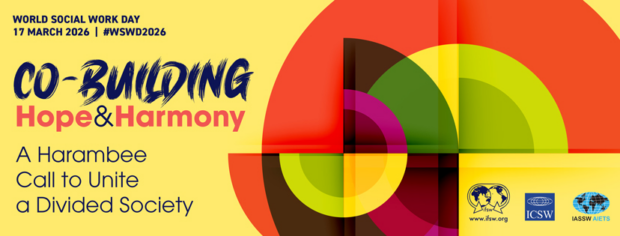
Harambe, a Swahili term, means all pulling together or let's unite. It's about co-building hope together and harmony. Harambe calls it uniting a divided society, it's African philosophy, emphasising things like collective effort, social cohesion, resilience against division. I think world social work is seeking to explore some key questions. How can social cohesion be fostered in those marginalised communities? How can you work with conflict and polarisation and exclusion? How do you kind of overcome some of these things? How can social work contribute to building resilient communities? How can social workers and wider organisations collaborate for inclusion, resilience and peaceful society?
Social work doesn't happen in a vacuum and I’m wanting us to be ambitious in this space. The answer to that is in the heart of social work itself. Our profession, from my perspective, has always bridged divides, and that's just not bridging it in a singular sense, it's between systems and people, between trauma and possibility, between fear and connection. We do the whole lot in social work. In West Yorkshire we had the MP, Joe Cox, who is no longer with us. Her message still echoes for me, which is we are far more united. And I think that belief in ourselves is one of our region’s and our local authority’s, quiet superpower.
That message speaks directly to what social workers do every day. We hold theperson in mind, their biography, their culture, their faith, strength and aspirations. We work relationally with compassion and courage, helping people to feel safe, because we talked about safety earlier on and how whether I felt safe or not, but whether people feel safe, whether they're understood and whether they feel connected or not. And connection is important. I think Bradford is one of those places that is faced with lots of misconceptions about it but especially around disability, race, faith, and you just talked about migration. The concept of migration is huge because that's an issue that comes up time and time again. And Harambe for me reminds me that unity is not passive. It's something that we build through shared humanity, through one conversation, one action and one relationship at a time to build on.
On what other can learn from Bradford
Robert Lewis
What do you think other areas could learn from Bradford and your city’s approach to cohesion?
Fazeela Hafejee
I think communities are really powerful in Bradford. We've got a really strongvoluntary sector organisation partnership. When I talk about Bradford, I don't talk about local authority. I talk about Bradford in its broadest sense - our partners, ones you wouldn't normally think of in the culture, leisure, arts, and tourism sectors.
So that emerging place-based cohesion framework and a public sector that understands the value of relational and hyper-local work is really important. Bradford is really complex. We've got high levels of poverty. I think we've got that highest number of young people in Bradford. In Bradford there'll be nice parts of leafy Bradford that border around North Yorkshire and then you work in city, high levels of deprivation and you can see that visually on a heat map. You see it and it's really stark. But there are partnerships across children's, adults, health, education, voluntary sector, because I think cohesion is everybody's business. What other places can learn from Bradford is the refusal to treat diversity as something to be fixed, but seeing it as an asset, as a driver that creates community strength, a sense of social renewal - that belonging is built locally through relationships and not rhetoric. And that message that I mentioned earlier on about being far more united is that quiet superpower.
On leadership in social work
Robert Lewis
What kind of messages or insights do you have around developing leadership in the kind of environments we work in?
Fazeela Hafejee
I didn't do the linear social work traditional career path. I started in advocacy and ended up working in national organisations. I then came into local government, went back out to working for national organisations. I’m now back in local government. I think most social workers have quite a linear career. They qualify as a social worker, become an experienced social worker, team manager, and that's fine, there's no right or wrong. But that path has taught me that you don't need to be in a social work post, values travel and that leadership isn't just a title. Shaping cultures where people feel safe to think boldly and act with compassion. People may have been historically excluded from leadership roles, as a leader you have a responsibility to actively open those doors and building the tables that you don't see. Especially for practitioners who may not see themselves reflected in senior leadership. I think visibility is really important. But leadership, like social work, is a team sport. I think we rise together. We're more united when we make spaces for everyone's brilliance. So yeah, it's not a one-man event. When you talk about being raised by a village, leadership is very much like that, it is a team sport.
Robert Lewis
I like the phrase about values travelling. I also like that idea that, as a social worker, you are not fully defined by your employer. The linear social work careers you mentioned become understandable when you think of continuity of service, pension, and so on, but they are also potential limiting and work against being more ambitious – more outward facing, perhaps.
Fazeela Hafejee
I think fear compounds us, doesn't it, really? And I think when I was in my first role, I was a single parent for a while. So that fear is even more compounded. You know, if I step out of this role where I'm really supported to be a mum, and to have the opportunity to have a job. And if I go elsewhere, what if I don't have that? Actually, from my experience, if you are in anything like a public sector, if you are not supportive of our colleagues, then the organisational culture is absolutely wrong. I've never had a plan, but I've always been true to myself and I will only do jobs that absolutely interest me and make me want to go to work. So, it's less about being career oriented, but it's more about being passionate about what you do. I think that's probably the key.
Robert Lewis
I like what you described is that sense of not waiting for others. You're not waiting for permission. The fact that you're there, the fact that you're wantingto do something is permission enough. And a strength in its own right, as well. There's got to be strength in that to carry that approach out and that definitely comes across from what you're saying.
Fazeela, thank you so much for speaking with me. I really appreciate your time and insights.
Fazeela Hafejee
No, it's been great chatting to you.
Robert Lewis
Thank you so much.
This above is an edited transcript with some adjustments made for word count purposes.
Leave a comment