Sarah McClinton, Chief Social Worker for Adults: I’m very happy to introduce this blog from valued National Adult Safeguarding Board member Professor Michael Preston-Shoot. Professor Preston-Shoot is an independent Safeguarding Adults Board chair and Emeritus Professor of Social Work. Michael brings a valuable perspective spanning national leadership, local safeguarding governance and social work academia to the national board. In this blog, he explores how learning from reviews, research and the experiences of people with lived experience can help shape and strengthen safeguarding policy and practice.
From Learning to Action - Blog by Professor Michael Preston-Shoot
The establishment of the National Adult Safeguarding Board (NASB) is a milestone in the development of adult safeguarding law and policy. It represents a significant opportunity to strengthen accountability at all governance, policy and practice levels. It also represents a significant opportunity to collate learning about the effectiveness of adult safeguarding law, policy and practice. As Stephen Kinnock, then Minister of State for Social Care, said in his introductory remarks at the inaugural NASB meeting, we all have a responsibility to listen, to hear and then to act.
We have no shortage of learning about what is working well in adult safeguarding and where there continue to be shortcomings. It comes from people with lived experience of adult safeguarding, and from practitioners who have had the privilege to work with them. It comes from two national analyses of safeguarding adult reviews, Care Quality Commission assessment of local authority safeguarding outcomes, and from research and briefings published by Research in Practice, the Local Government Association, and the National Network for Safeguarding Adult Board Chairs.
Collating this learning directs reflection across five domains: direct practice with individuals at risk of, or experiencing abuse and neglect, inter-agency collaboration and co-operation, organisational support for practice and service development, governance, and the national context. This learning encourages reflection not just on the evidence of good practice and shortcomings in each of the five domains, but also on the degree to which there is or is not alignment across the domains. In other words, is what is happening in one domain supporting or hindering work in another domain?
The NASB has already begun to lead on, and oversee projects that are designed to translate learning and reflection into change. Most notably, findings and recommendations from the aforesaid learning will be used to inform and to co-produce revisions to the Care and Support Statutory Guidance, especially chapter 14 on safeguarding, and subsequently to contribute to the review of legislation.
However, learning and reflection as a precursor to change is not just an NASB responsibility. It is a key responsibility of Safeguarding Adults Board, with their mandate to seek assurance about the effectiveness of adult safeguarding, to collate outcomes from reviews and audits, and to action plan where shortcomings are found. Learning and reflection for change is also a responsibility for commissioners and providers, working together and with people with lived experience of service provision, to strengthen provision where it is working well and to remedy gaps where these are found.
Learning and reflection for change must also be a central thread of every multi-agency meeting where risk is a key concern. It involves drawing on knowledge and experience of adult safeguarding, including legal literacy, and sharing this not just with colleagues across health, housing, social care, uniform services and others, but crucially also with those individuals at the centre of our work and, where appropriate with their families, friends and advocates. This is the link to making safeguarding personal and to giving meaning to the six principles of adult safeguarding in work with individuals at risk of, or experiencing abuse and neglect.
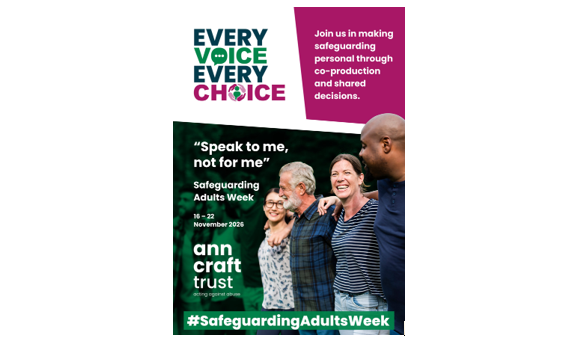
Adult safeguarding week should not be the only time where all of us involved in adult safeguarding reflect on what we have learned and what we should take from that learning into our contributions to practice, the management of practice, service development and/or policy review. However, it is a week where for a time all of us can step back, pause, take stock and refresh in order to continue our human work with determination, compassion, openness and commitment.
Leave a comment