Introduction from Sarah McClinton
I am delighted to share this blog from Professor Jerry Tew and Nick Sinclair, whose expertise and commitment have made an important contribution to the development of Family and Group Conferencing for Adults. It is particularly pleasing to see how far Family Group Conferencing for Adults has developed from my time as the DASS in Camden where the approach was incubated and nurtured and our research partnership with Jerry and University of Birmingham began. I am grateful to Jerry and Nick for setting out so clearly how this strengths-based approach can help put people, families and wider support networks at the heart of care and support planning, enabling adults to take greater control over decisions affecting their lives, strengthen relationships, and support more coordinated, person-centred care.
Professor Jerry Tew writes:
Although it is now widely embedded in Children’s Services, Family and Group Conferencing (FGC) is a relative newcomer in adult social care and health services (you may notice that we have inserted the word AND between Family and Group to reflect that, for many adults, their network may include friends, neighbours and others). FGC offers a process whereby individuals, supported by their networks, can take control over the decisions that affect their lives, and make plans for the future. It also offers a valuable space for a conversation with all the various professionals and services that may be involved.
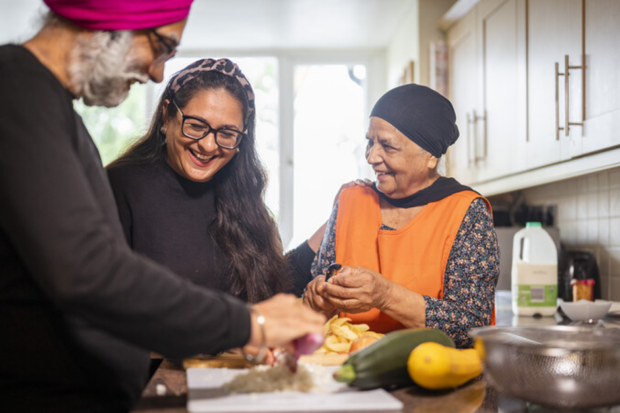
Typically, the Conference starts with the sharing of food and an opportunity for everyone to get to know one another ‘on a level’. This sets the tone for very different sorts of conversations – both with professionals and within the person’s network – from those which might normally take place in other settings.
There then follows Private Time which is the radical core of the process. In this, the individual and their network take as much time as they need to agree what they want to go into their Plan – which can then be finalised with any professionals or agencies that may be involved in providing ongoing support. Crucial to success is the quality of preparatory work that goes in beforehand, and the support for implementation and review afterwards. The values and practice of FGCs are inherently strengths-based and co-productive – and therefore fit well within a wider ethos of practice frameworks that emphasise relational and strengths-based practice.
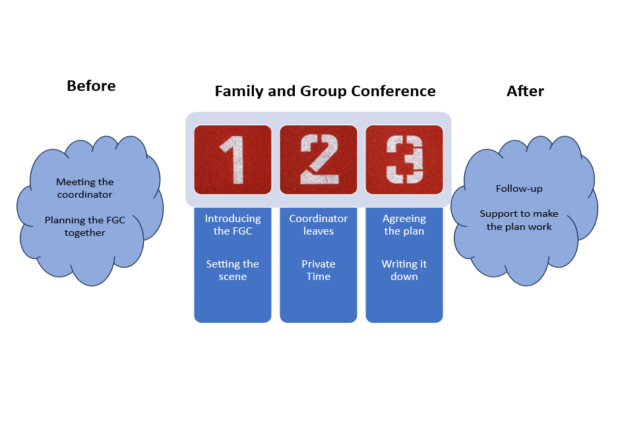
We have just come to the end of a 3 year research project investigating FGC practice with adults that was funded by the National Institute for Health and Care Research (NIHR). A key message that comes out of this is that the process of FGCs can bring about broader changes in people’s lives, over and above the primary outcome of coming up with a viable plan. These can include:
- Enhanced wellbeing and opportunities not just for individuals but also for informal carers - with previously isolated carers feeling that they were now able to share responsibility within a wider support network.
- Empowerment through
- being recognised (rather than being processed) by wider service systems
- strengthening of family and social networks
- better understanding of a central person’s needs and preferences by family, social networks and/or professionals
- Reduced risk with a more efective safety net
- Support for life changes and transitions.
The research has shown that the typical cost of a full FGC (including all professional time inputs) is around £1500 per FGC. Set against this were potential savings in overall service costs of around £3500 in Year 1, in comparison with those receiving ‘service as usual’ – indicating that offering FGCs can contribute significantly to preventing, reducing or delaying health or social care costs that might otherwise accrue.
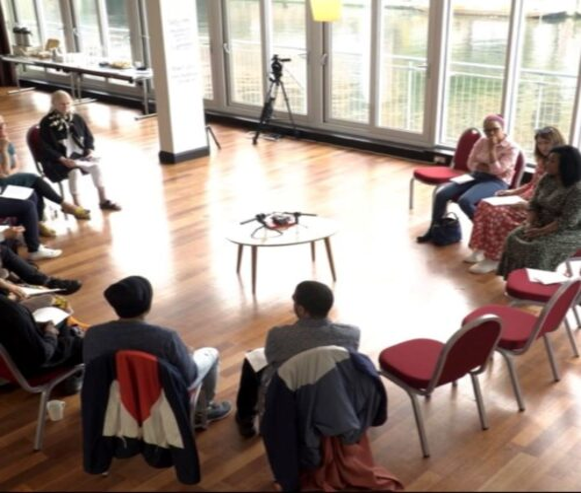
In conjunction with Research in Practice, we have produced 3 sets of information and learning resources, incorporating video and other material produced by people with experience of FGCs, FGC co-ordinators and managers. There are resources for:
- Members of the public who may be interested in or considering having an FGC
- Commissioners and managers interested in setting up an FGC service
- Training and development of practitioners involved in facilitating FGCs
These resources also showcase our newly developed Standards and Guidance for FGC for adults and how they may be used in developing services and reflecting on practice.
Nick Sinclair, Programme Director at Community Catalysts writes:
We have been proud to host the Research and Practice Network for Family and Group Conferencing for Adults since 2022, and we host information, stories from practice and findings from research on our website.
Over that time, we have grown a deep appreciation for this valuable approach. It is clear it can do much to humanise the care and supporting planning process and bring to life the vision of “a good life for everyone” through greater choice and control and by bringing people’s strengths (and that of their networks) to the centre of planning for their care.
The latest research from the University of Birmingham captures the potential impact of the approach on people’s lives, and also shows the basis for a clear financial incentive for investment.
We are delighted to now be utilising these findings as a springboard to support more areas to adopt the approach.
We have gathered a small group of local authorities to “Test and Learn Together” as they start a new FGC for Adults service. This innovative accelerator programme sees Community Catalysts working hand-in-hand with Camden Council to enable areas to design a high-quality, well-embedded offer. Councils joining us on this journey are: Brent, Richmond and Wandsworth, Central Bedfordshire and Hartlepool.
Our hope is that, as FGC for Adults gains momentum across the UK, more people will be able to take control of their own futures, decide the care and support that is right for them and experience the support of informal and formal services in a much more coordinated, person-centred way.
To find out more about the Test and Learn Together and the wider work supporting the FGC for Adults Network contact us at info@communitycatalysts.co.uk