Introduction from Sarah McClinton
This blog marks Mental Health Awareness Week 2026 with a thoughtful reflection on what it means to move beyond awareness and towards meaningful action. It explores how mental health social work can help rebalance power, place and experience by centring lived, strengthening co-production, and reconnecting support with the communities where people live their lives.
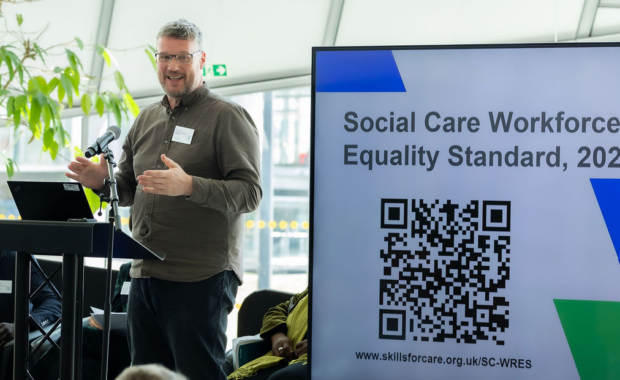
Written by our Mental Health Social Work Lead in the Department of Health and Social Care, Robert Lewis, whose personal perspective brings both professional insight and a strong commitment to more relational, rights-based and person-centred practice.
Rebalancing Power, Place and Experience - a personal reflection by Robert Lewis
Having had the privilege of working across all types of mental health service for the last 30 years, I’ve always been troubled by the notion of the primacy of professional expertise and experience.
For my own conceptualisation if nothing else, I have long believed that as professionals we do not own ‘mental health’. Mental health does not belong to us. Rather, of course, it belongs to the people who experience such challenges in their lives. For those whose lives are impacted so heavily, they can find themselves forced to accommodate our expertise and experience – our institutions, our models and approaches, our anxieties, and career prospects. It has always seemed unbalanced.
As professionals we are adept at exploiting that living experience and mining it for our own sense of professional value, legitimacy, and in the justification of the choices we make about others. It has always seemed dishonest, even if we do not realise this is what we are doing.
What we do own as professionals, I believe, is our response to the lives we are presented with. With the positions afforded us by our registrations and approvals, we have resources and systems at our disposal. We can make choices about how they are deployed, denied, and importantly how they are constructed.
Mental Health Awareness Week 2026 calls on all of us to move beyond awareness and into more meaningful action.
For mental health social work, this is both a challenge and an opportunity. It asks us not simply to reflect on what we do, but to fundamentally reconsider who we are here for and how and with whom we can design and deliver our support. If we accept the proposition that professionals do not exclusively own mental health expertise and experience, we need to be working much more meaningfully with those who do.
For too long, our systems have been configured around services rather than people - around clinics, wards, thresholds and pathways, rather than communities, relationships and lived realities. Social work has always held a different lens: one that situates mental health within the social context of people’s lives. This week provides a moment to reassert that perspective and to push it further. In the current policy environment, that door has a sign that says “open” – we need to test out the reality of this.
Re-centring lived and living experience
At the heart of this shift must be a clear commitment: lived and living experience is not an adjunct to service design - it is foundational to it. It is not easy – especially when working in systems that have yet to gear themselves up to accept the challenge and make our stated commitments meaningful. And yes, in saying these things I am stealing from those with lived experience. I do so in the hope of proving the point. We need to draw legitimacy from each other. We need a more honest dialogue.
Co-production offers a framework for this transformation. It moves us from doing things to or for people, to working with as equal partners, recognising that those most affected by the services are best placed to shape them. When this is done meaningfully, it challenges traditional hierarchies of expertise, redistributes influence, and creates more responsive, equitable systems.
But co-production is only as strong as our willingness to share power. There is a continued risk of tokenism - where involvement is visible but not influential. For social workers, particularly those working within statutory frameworks such as the Mental Health Act, this presents a profound professional question: how do we exercise our legal responsibilities while actively creating space for the voices of those whose liberty and care we are determining?
The answer lies not in abandoning professional knowledge, but in integrating it with experiential knowledge - treating both as essential, complementary forms of expertise. It can start with a conversation.
It always surprises me how mental health professionals seem able to talk to people when they are unwell yet struggle when they are in good health and ready to contribute to our learning. Maybe we are talking to, and not with.
Shifting from institutions to neighbourhoods
Alongside rebalancing power, we must also rethink our workspaces. National policy is encouraging us: the future of health and care lies in neighbourhood-based models that bring support closer to where people live.
The focus on neighbourhood mental health centres, is one such vision - open access, continuity of relationships, and integrated teams working alongside community partners and peer support workers. “An ordinary house on an ordinary street”; principle-led, not a formulaic and rigid. These models promote accessibility, early intervention and holistic care, reducing reliance on crisis pathways and inpatient settings.
For mental health social work, these approaches can align directly with our values: understanding people within their family, community and cultural contexts, and recognising the social determinants that shape mental health. It also creates space to build on existing community assets that are too often overlooked.
Maximising choice and least restrictive practice
Co-produced models sit neatly with long-standing social work principles. Our professional responsibility is to ensure anything we are part of developing is rights-promoting, citizenship-building, inclusive, accepting, safe, reflective, and genuinely interested in the people who turn up at our door - or whose doors we turn up at.
Too often, the absence of accessible, community-based alternatives leads to more restrictive interventions. When support is fragmented or distant, detention becomes more likely - not because it is always clinically necessary, but because other options are not realistically available.
By contrast, integrated, local provision - with flexible, personalised responses - enables earlier help, sustained relationships and a broader range of options. This is not only better for individuals; it is also fundamental to reducing inequalities in access, experience and outcomes.
Of course, there is a place for the clinic, the hospital, the specialist environment, but it should not be at the expense of starting where mental health need starts or the people who experience the very real challenges it can have to maintaining and achieving an ordinary life. And of course, professionals have expertise and experience, but what good is it if it does not connect.
My action this week
Mental Health Awareness Week 2026 asks us to consider some personal action we might make.
Recognising that I am in a very unique and privileged position - and based on all that I have just set out - it would be easy for me (even expected) to bullet point words and phrases like embed co-production, share the power, and open the space for others and encourage my social work colleagues to follow suit. I feel the weight of all of that expectation, I really do. Instead however, in the interests of my own mental health, my action for this week is:
- to be kinder to myself
But please, let's find time to talk about those other ideas too. I am here for it.